
CPR in Newborn
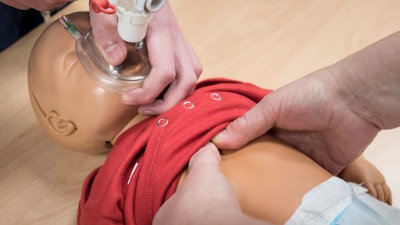
CPR in Newborn is different for a variety of reasons. The body is much more fragile and requires care when attempting CPR. Bones are softer and risk injury. CPR in a newborn is different from adult CPR and is usually done as part of newborn resuscitation (NRP). If a newborn is not breathing normally or has a very low heart rate, this is an emergency—call local emergency services immediately and follow their directions if available.
Hands-on training (NRP) is strongly recommended. Both parents should seek CPR training for a newborn before their child is born. Many hospital will send you home pretty quickly after delivering your child. As a parent of a newborn, you want to be sure what to do and how to do CPR for your child. The nightmare of not knowing how to administer proper CPR is completely avoidable with proper training. Infant and child CPR is taught in all classes involving infant/child CPR
WHEN TO START CPR (NEWBORN)
1) Warm, position airway, clear secretions only if obstructing, dry, stimulate.
2) If the baby is apneic/gasping or the heart rate is under 100 bpm:
- Start positive-pressure ventilation (PPV) with a newborn bag-mask.
3) If after 30 seconds of effective ventilation the heart rate is under 60 bpm:
- Start chest compressions with ventilation (CPR).
KEY POINT: In newborns, ventilation is the priority. Most newborn arrests are respiratory, so good breaths come first.
CHEST COMPRESSIONS (NEWBORN)
Hand technique (preferred):
- Two-thumb encircling method: place both thumbs on the lower third of the sternum (breastbone), fingers encircle the chest and support the back.
Location:
- Lower third of the sternum, just below an imaginary line between the nipples (avoid the tip of the sternum).
Depth:
- About 1/3 of the chest’s front-to-back depth.
Rate:
- 90 compressions per minute (when combined with breaths per the 3:1 ratio below).
COMPRESSION:VENTILATION RATIO (NEWBORN)
- 3 compressions : 1 breath (3:1)
- Goal: 120 “events” per minute total = 90 compressions + 30 breaths.
A common cadence is: “One-and-two-and-three-and-breathe…”
REASSESSMENT
- Reassess heart rate about every 60 seconds (or per NRP flow).
- If the heart rate rises to 60+ bpm: stop compressions but continue ventilation as needed.
- If 100+ bpm and breathing well: supportive care/monitor.
IF YOU DON’T HAVE A BAG-MASK
- In many real-world situations, you may only be able to do mouth-to-mouth-and-nose rescue breaths. Use gentle puffs—just enough to make the chest rise.
- If you’re alone, call emergency services as soon as possible and begin ventilation/CPR.
As you can see in the above dialog, CPR for a newborn is different. I strongly urge all parents attend CPR classes for infants, before your child is born. Most hospitals offer this critical course for new parents. Be sure to take advantage of it.


Heartstart Heroes CPR & First aid
info@HeartstartHeroes.com or Contact Us
New Boston, Texas 75570
Copyright © 2021 –