
- Home |
- Infant CPR for Parents and Caregivers
Infant CPR for Parents and Caregivers
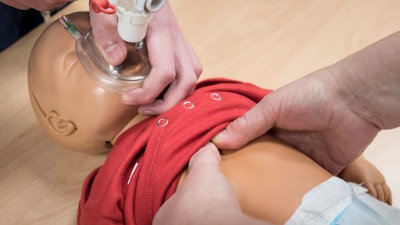
Infant CPR for Parents and Caregivers. Learn what to do if a baby is unresponsive or not breathing normally, including infant CPR, AED use, and infant choking response. This article is geared toward parents, family members, babysitters, and anyone caring for an infant younger than 1 year.
An infant can experience a life-threatening breathing or cardiac emergency unexpectedly. Recognizing the signs, calling for help, and beginning CPR promptly can make a critical difference. Because breathing problems are a common cause of cardiac arrest in infants, providing rescue breaths along with chest compressions is especially important whenever a rescuer is able and willing.
Emergency: If a baby is unresponsive and not breathing normally, call 911 and begin CPR. Put your phone on speaker and follow the emergency dispatcher’s instructions. Do not delay CPR while searching for a pulse.
How to recognize an emergency
Check whether the baby responds when you gently tap the foot and speak to them. Look for normal breathing. Occasional gasps are not normal breathing.
If the infant is unresponsive, not breathing normally, and shows no signs of life, activate emergency medical services and start CPR. If another person is present, have them call 911 and retrieve an AED while you begin CPR. If you are alone, use your phone on speaker so the dispatcher can guide you.
How to perform infant CPR
- Position the baby safely.
Lay the infant on their back on a firm, flat surface. Begin chest compressions promptly.
- Give chest compressions.
Place your thumbs on the lower half of the breastbone and encircle the chest with your hands, or use the heel of one hand over the breastbone. Compress at a rate of 100–120 times per minute, to a depth of approximately one-third of the chest (about 1.5 inches or 4 cm). Allow the chest to return fully after each compression and minimize pauses.
The 2025 AHA/AAP guidance recommends the two-thumb encircling-hands or one-hand technique; the older two-finger method is no longer recommended for infant CPR.
- Provide rescue breaths when able and trained.
After 30 compressions, open the airway with a gentle head tilt and chin lift, avoiding excessive neck extension. Seal your mouth over the baby’s mouth and nose, give 2 gentle breaths lasting about one second each, and look for the chest to rise. Use only enough air to create visible chest rise; avoid forceful or excessive breaths.
For a single rescuer, continue cycles of 30 compressions to 2 breaths (30:2). With two trained rescuers who can coordinate CPR, the ratio is 15 compressions to 2 breaths (15:2). Follow your current training and the emergency dispatcher’s guidance.
If you cannot or are unwilling to provide breaths, give continuous chest compressions rather than doing nothing. CPR with breaths is preferred for infants when possible.
- Use an AED as soon as one is available.
Turn on the automated external defibrillator (AED) and follow its spoken instructions. Pediatric pads and an energy-reducing pediatric setting are recommended when available. If an AED with pediatric attenuation is unavailable, a standard AED may be used. Follow the pad-placement directions and make sure the pads do not touch each other. Keep interruptions in CPR as short as possible.
- Continue until help takes over.
Continue CPR and follow the AED and dispatcher instructions until the infant shows signs of life, emergency professionals take over, or you cannot safely continue.
What if the baby is choking?
An infant who can still cough or cry effectively may be able to clear the airway. Stay close and watch for worsening breathing difficulty.
If the infant has a severe airway obstruction and cannot breathe, cry, or cough effectively, call for emergency help and alternate 5 back blows with 5 chest thrusts, using the heel of one hand for the chest thrusts. Repeat until the obstruction is relieved or the infant becomes unresponsive.
Do not perform abdominal thrusts on an infant. Do not use blind finger sweeps. If the infant becomes unresponsive, begin CPR, starting with chest compressions. Remove an object from the mouth only when you can see it.
Infant choking response and infant CPR are related but different emergency skills. Hands-on instruction is the best way to learn correct positioning and techniques.
What about CPR immediately after birth?
Resuscitation of a baby during the immediate transition after delivery may involve a separate healthcare-professional approach called neonatal resuscitation. Its ventilation priorities and compression-to-breath ratio are different from the infant CPR guidance on this page.
For an emergency involving a newly born baby outside a clinical setting, call 911 immediately and follow the emergency dispatcher’s instructions.
Learn more: Neonatal Resuscitation at Birth: Understanding the Clinical Approach
Be prepared before an emergency
Knowing CPR is valuable, but reading about it is not the same as practicing with an instructor. Heartstart Heroes CPR & First Aid offers hands-on CPR and first aid education. Ask about classes covering infant CPR, AED use, and choking response.
Explore training options: https://www.heartstartheroes.com/Book-a-Class.html
Important: This article is for general public education and does not replace instructor-led training, emergency dispatcher instructions, or professional medical care. In an emergency, call 911.
Sources and further reading
American Heart Association / American Academy of Pediatrics, 2025 Pediatric Basic Life Support Guidelines:
https://cpr.heart.org/en/resuscitation-science/cpr-and-ecc-guidelines/pediatric-basic-life-support
American Heart Association, 2025 CPR guidance and choking-response updates:


Heartstart Heroes CPR & First aid
info@HeartstartHeroes.com or Contact Us
New Boston, Texas 75570
Copyright © 2021 –